

An exchange needs a lot of information from its traders to properly process their orders, but how much of that information needs to go to the rest of the market?
This is one of the biggest design decisions an exchange can make.
A brief history
Historically, the large, regulated traditional exchanges have displayed only the minimal information that traders need to construct their own local copy of the order book, such as symbol, price, side, and quantity.
The DeFi world, with its aim of producing fully auditable, decentralized finite-state machines as exchanges, was forced to disseminate rather more information in order to function. Rather unsurprisingly, this has led to safety issues around MEV, leaked positions, liquidation prices, and stop orders, and to a pragmatic pullback from the ideals of ‘full decentralization’.
In the next series of articles, I will see how we can continue to make the case for privacy. By the end of the series, we will explore territory that is as yet unfamiliar to the world of perpetual futures and highlight areas where QFEX can grow, borrowing the ideas that made TradFi markets great.
The passive trader’s dilemma
Suppose our model values a stock at $100.10; we want to buy 50,000 shares, and the current price is $100.00. Ignoring fees, buying the full quantity at that price would give us $5,000 of expected edge.
So, we send the order.
Other traders now know that a large buyer is willing to pay $100. Some bid $100.01, ahead of us on price, competing for passive flow. Our order has leaked a supply-demand imbalance in the market; others withdraw their offers or become less willing to sell. It also acts as an exit option by offering others liquidity to exit a long position in case the price doesn’t rally.
We eventually decide to chase the market and complete the position at an average of $100.07.
Against the same $100.10 valuation, our expected edge is now $1,500. Seven cents sounds small, but it consumed 70% of the opportunity.
That is why the fee schedule is only one part of execution cost, even for passive traders. A venue can charge very little per trade while its disclosure rules make the position much more expensive to build. In our example, saving a fraction of a basis point in fees would do little to recover seven basis points of lost edge.
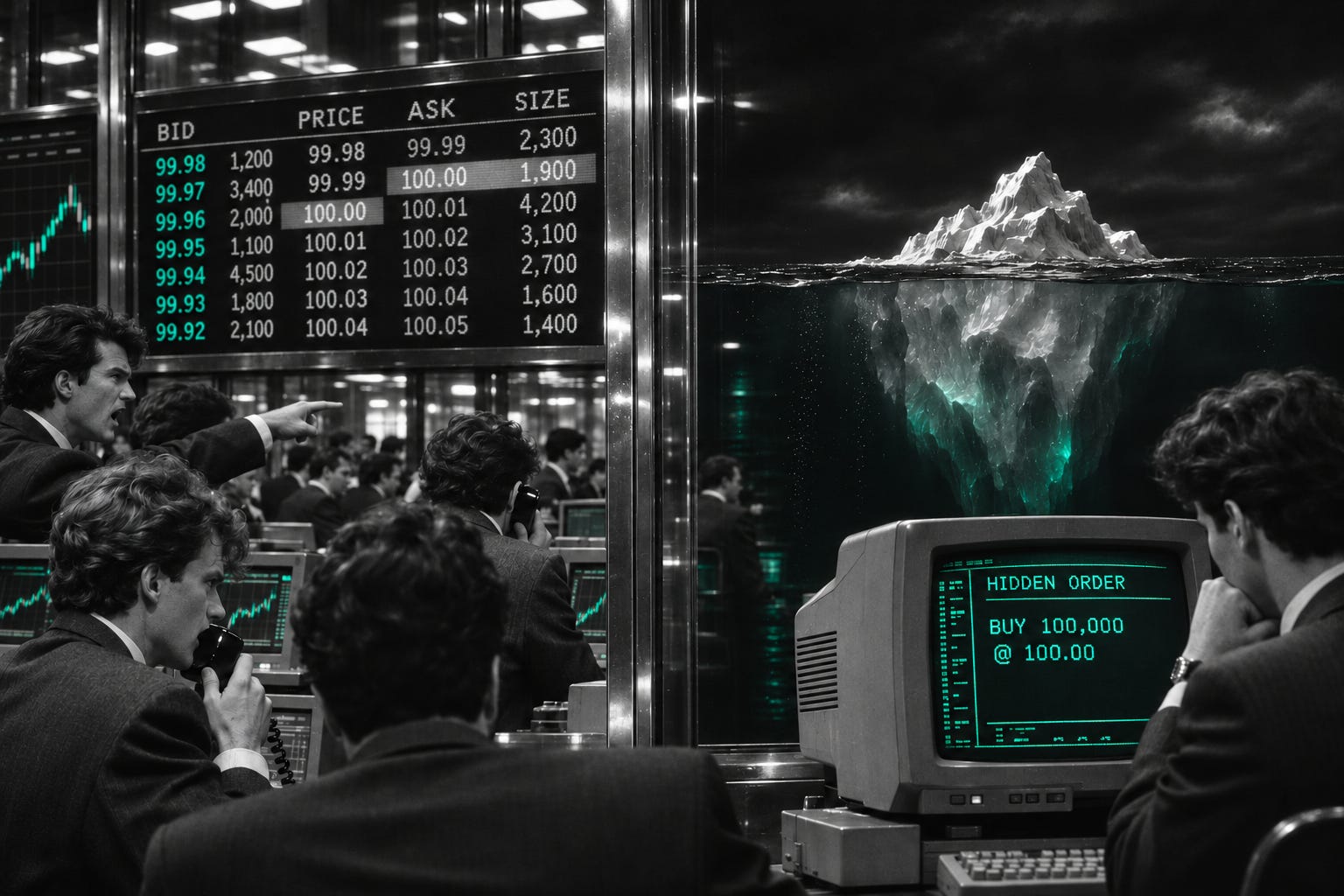
Privacy can change whether someone trades
This problem cannot just be fixed with a different execution algorithm; it is foundational to the leakage of our intent. We must either reduce our size, quote a less competitive price, or stay away, none of which may be desirable.
There is a concrete institutional example. In a 2020 submission to the CFTC, Citadel said concerns about information leakage and retaliation had prevented it from accessing certain swap venues. The issue was disclosure of counterparty identity after otherwise anonymous trades.
An exchange considering confidentiality therefore has to ask what information disclosure does to the liquidity people are willing to supply. Requiring more information does not guarantee that the same orders will arrive and reveal it.
Enough information to find a trade
The useful question is how much information a trader must disclose to obtain an execution, and how much the venue can keep confidential without preventing willing buyers and sellers from meeting.
We are working on Private Orders at QFEX because this is a design barely explored in the crypto industry, and we believe that these choices should be available to the trader. The starting point is simple: getting a trade done should not require telling every spectator as much as the matching engine knows.