

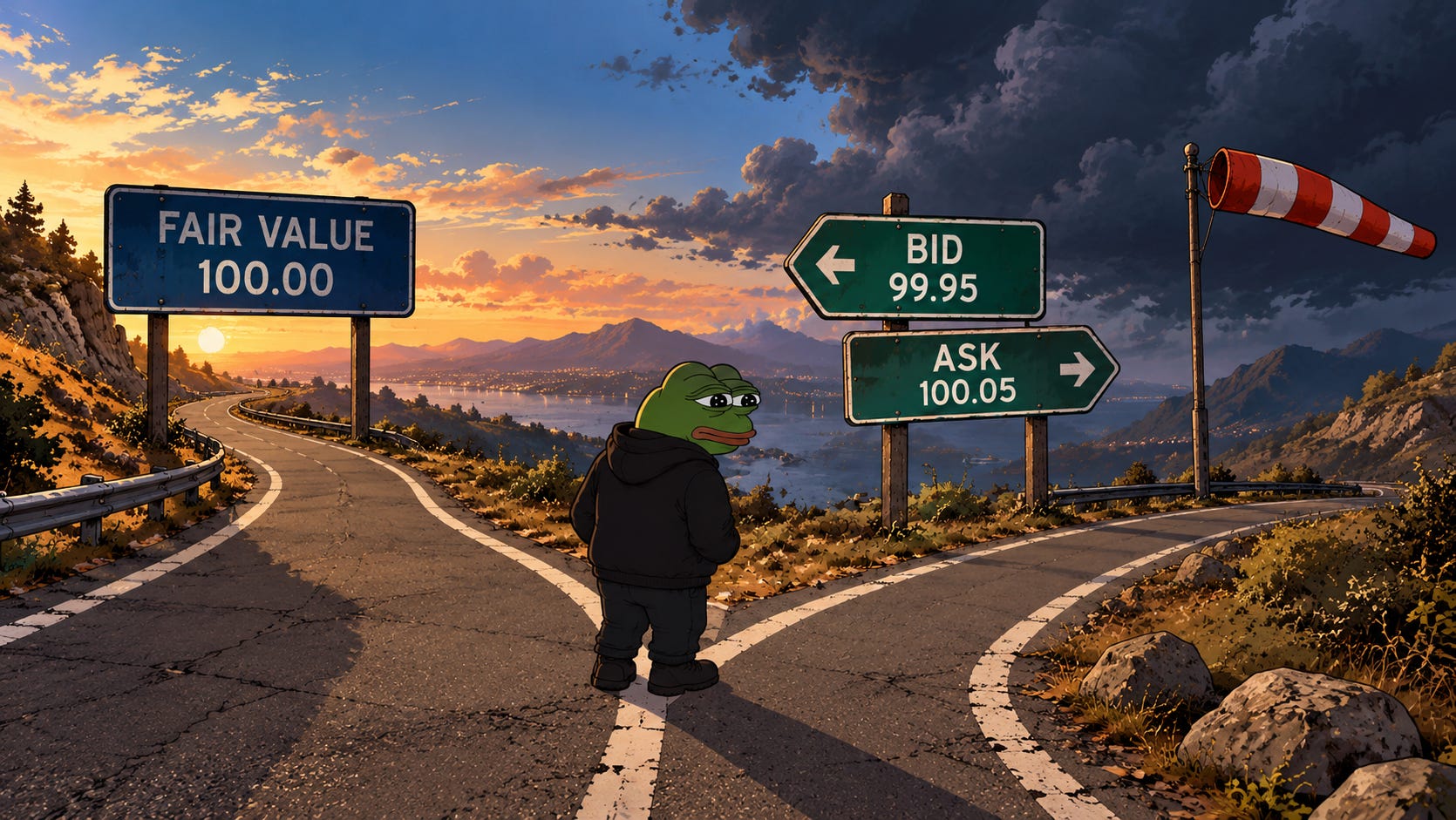
Given a fair value of $100, where should I bid and offer? How wide should I be? Should I always be symmetric around $100?
Fair value is an estimate of economic value. A quote is a willingness to transact; equivalently, it’s the sale of an option for someone else to take that price. Between those two things sit uncertainty, fees, adverse selection, inventory, tick sizes, exchange rules and the simple fact that other people may know something you do not.
Let’s see how a pricing model becomes a market-making strategy.
Start with an edge
Suppose fair value is 100.00 and we require 5 bps of edge on either side. Ignoring everything else, our theoretical prices might be roughly:
The ten-cent spread is not a prediction that price will bounce between those levels. It is compensation for providing immediacy and accepting the risk that whoever trades with us has better information. What should the spread be a function of?
Uncertainty should widen symmetrically
Imagine the leader market suddenly becomes volatile. Our fair-value estimate still says 100, but it is moving rapidly and may be stale by the time an order reaches the exchange.
The rational response is not necessarily to move fair value. It may be to become less certain about it.
That uncertainty can be represented as additional widening. Three useful inputs are:
leader spread — a wider source market often means less precise price discovery;
short-term volatility — a price moving quickly creates latency risk;
staleness — old information should be expensive to trade against.
Conceptually:
A model can therefore keep producing approximately the same central estimate, while the quoting layer backs away dramatically during uncertain conditions.
Inventory risk should skew asymmetrically
The other big way that we may wish to modify our fair value is asymmetrically.
Let’s decompose the ‘half-spread’ formula above as edge + penalty, where we anticipate that we can trade (on average) for no profit if we cut down half-spread to just ‘penalty’.
It is then reasonable to cut our edge back to 0 if we are in a large position that we wish to reduce, and prudent to increase the edge demanded if we are entering larger and larger positions.
At first, it appears that this change is conceptually very different to pricing, but it actually forms the basis for price discovery. a large buyer can cause all of the market makers to go short and therefore move up their bids and offers asymmetrically as they attempt to shed their risk. Overall, buying pressure moves prices up.
A more mathematical way to see this, is simply to observe that a feature of the type that measures the imbalance in buy and sell trades is simply measuring the inventory skew of all market makers combined. This feature is very powerful.
One quote or an order train?
Many market makers do not post one order per side. They post a sequence of orders at increasing distances from fair value.
For example, a buy train might place small quantities at 99.95, 99.90 and 99.80. The closest order has the highest chance of filling but the least edge. Deeper orders have more edge and can provide liquidity if the market moves through the first level.
Order trains introduce another constraint: your own orders should not compete incoherently with each other. Spacing, total resting quantity and replacement logic all matter. More orders do not automatically mean more liquidity: badly managed orders can just create more state to reconcile.
The output of the quoter
A clean architecture makes the quoter almost boring. It receives:
fair value and model health
uncertainty inputs
current inventory and limits
current market state
instrument and venue constraints, and produces desired orders.
Crucially, ‘desired orders’ are not the same as live orders. The exchange may reject one. An old order may still be waiting for a cancel acknowledgement. A partial fill may have changed inventory between calculation and submission.
That is the boundary between strategy logic and exchange state, to be discussed in the next article!