

I post a lot about my time in trading, covering market microstructure, different asset classes and trading strategies.
So far, I’ve never spoken about crypto, either as an asset class or a trading strategy - mostly because QFEX doesn’t list crypto markets! However, I acknowledge that many of my readers will be interested, and since I spent the bulk of my career in HFT trading cryptocurrencies, it’s where my knowledge lies.
The first article in this series will cover the tokens themselves.
Fundamentally, Why Tokens?
Tokens are, simply put, a way for companies to distribute some utility in their product, using a blockchain to keep track of token ownership in a decentralized manner. Only the second part of that sentence involves crypto; the product itself does not need to involve blockchain, although if not, it usually involves something else that the crypto community is familiar with, like perps.
So why are tokens generated?
Since time immemorial (and certainly before crypto), companies have found ways to financially reward their earliest users. These benefits may include discounts, exclusive access rights (eg, to fundraising rounds), and straight airdrops.
There is no business model more suited to launching a token than an exchange.
Why?
Exchanges are unique amongst software products: their users aim to earn cash, not pay cash for some other value. Exchanges therefore need to make their users rich. One way is to list revenue generating assets (something we specialize in at QFEX) and avoiding PvP games like binary options (event contracts).
However, it also makes total sense to give their earliest users all the benefits of early cash liquidity, by airdropping them a token with no vesting. If the exchange is confident in the superiority of its product, then there is nowhere for those tokens to go back into genuine trades than the same exchange itself!
This creates a virtuous flywheel effect: early users are expected to get rich, and use the money to continue to trade on the same exchange. This is bullish for the exchange’s revenues, which, in turn, is bullish for the token’s price, cementing the exchange’s early trading activity. The exchange effectively borrows its market-expected future revenues, and pays them to the early users as a bootstrapping mechanism.
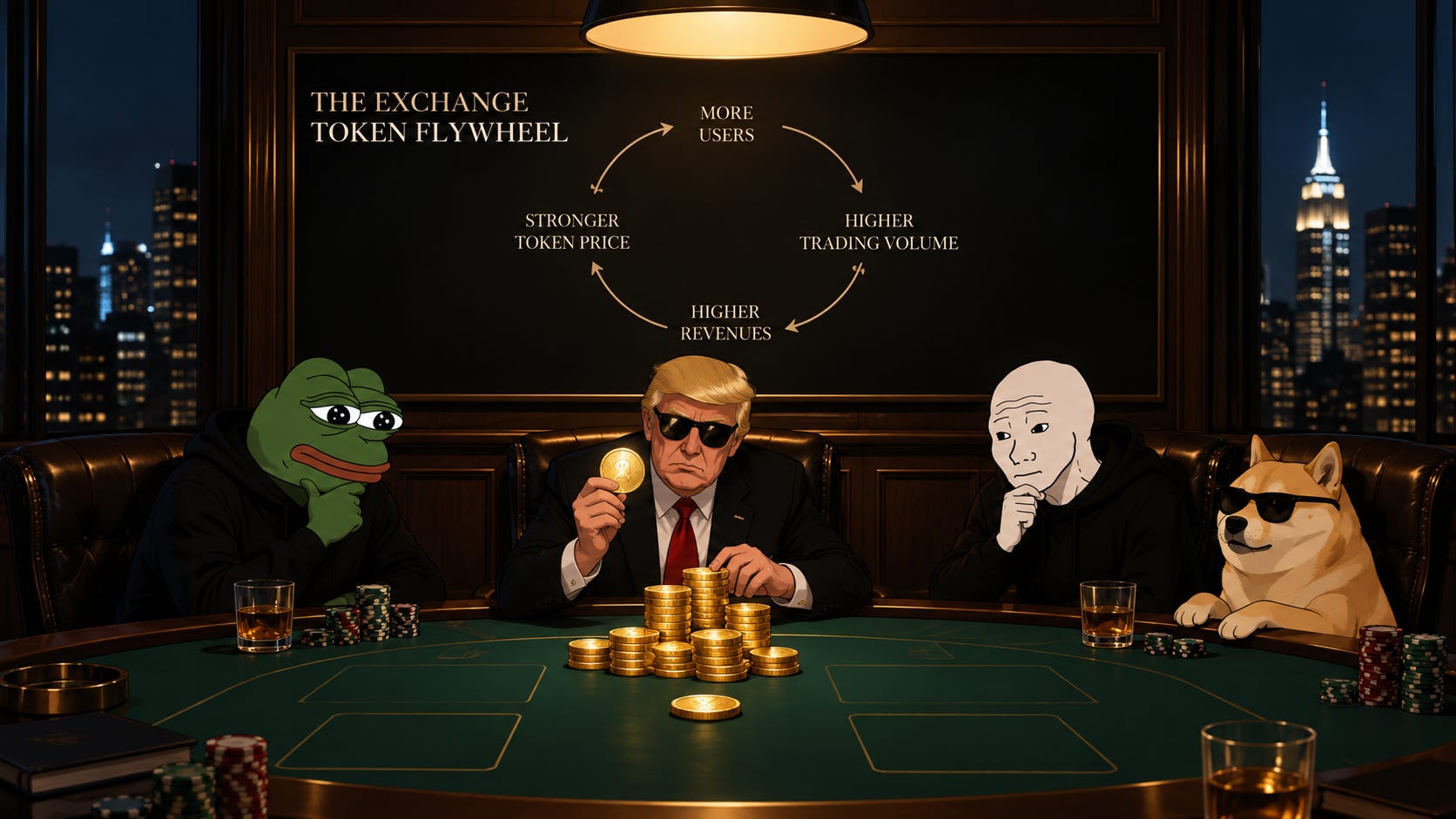
Like many other miracles in the free market, the team’s incentives are aligned with the community’s. If the new exchange does not improve upon the incumbents, the users will sell the token and leave for the incumbents. In fact, they may not come at all, since the airdrop is not expected to be a large sum anyway. Launching a token, then, is an existential risk for most exchanges. If an exchange’s early users want to help improve their airdrop, they can guide the team with criticism and feedback. It’s why our entire product roadmap at QFEX is user-driven, and flexible on a weekly basis.
Continued Demand
Further, unlike many crypto projects, after a token listing, exchanges have many natural ways to continue token demand.
Fee discounts are a concrete example. Binance currently offers up to a 25% discount on spot and margin trading fees when eligible users pay those fees with BNB. That gives an active user a benefit they can estimate in dollars.
Exchanges are also revenue-generating, which means that they have a ‘war chest’ of funds to compensate their community even when markets turn bearish and token prices become affected, as they invariably are. Many exchanges have liquidation vaults or ‘insurance funds’ - funds composed of money that belongs neither to the users, nor the exchange. Insurance funds tend to be high precisely when a lot of users have been liquidated - could these be used to repurchase tokens?
Points, Fees and Transparency
Trading has a price: trading fees, spreads, funding, slippage and so on. Many users will justify these costs with the expected value of whatever future rewards their activity might earn them.
Just like with credit cards, points are useful because they turn what would otherwise be vague speculation into something at least partially measurable.
If a trader spent $20,000 in fees trading on an exchange, but the future reward pool was worth $1 billion and points mapped proportionally to it, 0.2% would correspond to $2,000,000, more than offsetting the cost of the fees.
Such programs have to balance the trade-offs between being transparent and inciting unproductive activity that gamifies the system and takes points away from genuine users. A user should not have to blindly spend $50,000 in fees chasing an unspecified reward whose allocation rules can be changed retrospectively. At the very least, I think well-designed programs should be transparent about a few things.
Users should know what generates points:
> Volume?
> Fees?
> Open interest?
> Deposits?
> Referrals?
These are economically very different activities.
A badly designed points program can generate enormous headline volume while creating surprisingly little value for the exchange: at the early stages, this is anything that doesn’t help the exchange find PMF. To wit, I wish more exchanges would reward things like early user calls and product feedback, rather than just wash trading.
The Fee-to-Airdrop Calculation
The most interesting consequence is that sophisticated users will eventually start treating an exchange’s incentive program as another trade.
Very roughly:
Of course, the first number is uncertain. That is the entire game.
If earning $1 of expected rewards requires paying $5 in fees, sophisticated users eventually stop participating. If users can earn $5 while contributing only $1 of economic value to the marketplace, the exchange eventually has to reduce incentives.
Somewhere between those extremes is an equilibrium where the exchange is effectively sharing part of the value created by its early network with the people responsible for creating that network.
That, to me, is the point of the whole exercise.
The best token launches are mechanisms for deciding how much of the value created while bootstrapping a marketplace should accrue to the company, and how much should accrue to the users who took the risk of showing up before everybody else.
Early users are disproportionately important to an exchange; it follows that they should probably capture an unusually large part of that value.